Home → Florida 4-point inspection
Florida 4-point inspection: will this house pass before you buy?
A Florida 4-point inspection is a short insurance inspection of four systems: roof, electrical, plumbing, and HVAC. Insurers use it to decide whether a house is insurable.
TL;DR
- A Florida-licensed inspector fills out the insurer's form (Citizens publishes a sample) and signs it.
- The form sets no pass/fail thresholds. Each insurer sets its own rules.
- Under Fla. Stat. 627.7011, an insurer "may not refuse to issue or renew a policy solely because of the age of a roof less than 15 years old."
- Your county permit record can show roof, AC, plumbing, and electrical work dates before you book.
How to read this guide
What the 4-point is, and what it isn't
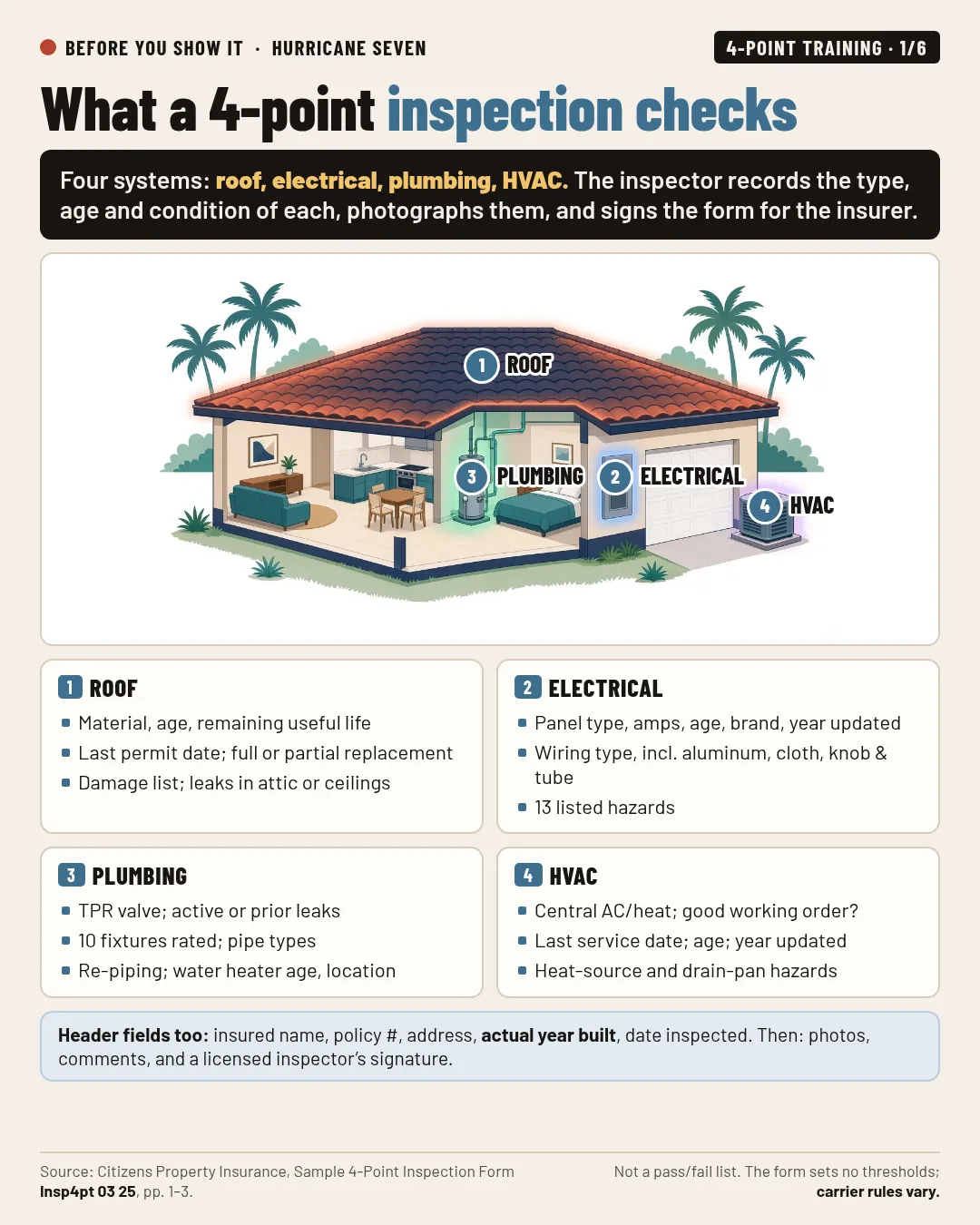
A 4-point is an insurance inspection of four systems: roof, electrical, plumbing and HVAC. The insurer's underwriting uses it to decide whether it will insure the house.
The inspection should take about an hour. If it takes much less, the inspector may not have been thorough. (Florida CFO guide)
A field-by-field training guide for home buyers and real-estate agents in Venice and Sarasota. Built only from the Citizens Property Insurance sample form Insp4pt 03 25, Fla. Stat. 627.7011 (2026), and Florida OIR material.
Training material, not legal or insurance advice. The form sets no pass/fail thresholds. Insurers set their own underwriting rules. Prepared October 10, 2026.
The form
Citizens publishes a sample form, Insp4pt 03 25 (4 pages). Citizens says the specific form is not required, but any other report "must include at least this level of detail to be acceptable" (p. 4). Citizens released this version on March 20, 2025; older versions are not rejected, but underwriting may follow up on missing information.
Header fields on every form: Insured/Applicant Name, Application/Policy #, Address Inspected, Actual Year Built, Date Inspected (p. 1).
What it is not
The form says the information "only is used to determine insurability and is not a warranty or assurance of the suitability, fitness or longevity of any of the systems inspected" (p. 1). It is not a full home inspection.
No thresholds on the form
The form records facts: ages, types, conditions, hazards. It does not state a maximum roof age, a minimum amperage, a banned panel brand or a banned pipe type. Those decisions belong to each insurer.
The only age rule in this guide comes from statute, not the form: Fla. Stat. 627.7011(5) on roof age (see Roof).
"Acceptable condition"
Citizens defines it: "each system is working as intended and there are no visible hazards or deficiencies" (p. 4). Citizens agents "may not submit applications for properties with electrical, heating or plumbing systems not in good working order or with existing hazards/deficiencies" (p. 4).
How each section is laid out
- An illustration.
- A field table: every field on that part of the form, with page cites.
- Red flags the form asks about: the checkboxes and yes/no questions that record a problem.
- What county permits can show before the inspection. A dated permit shows when roof, AC, re-pipe or panel work was permitted.
System 1 · Roof · Form p. 3
Roof
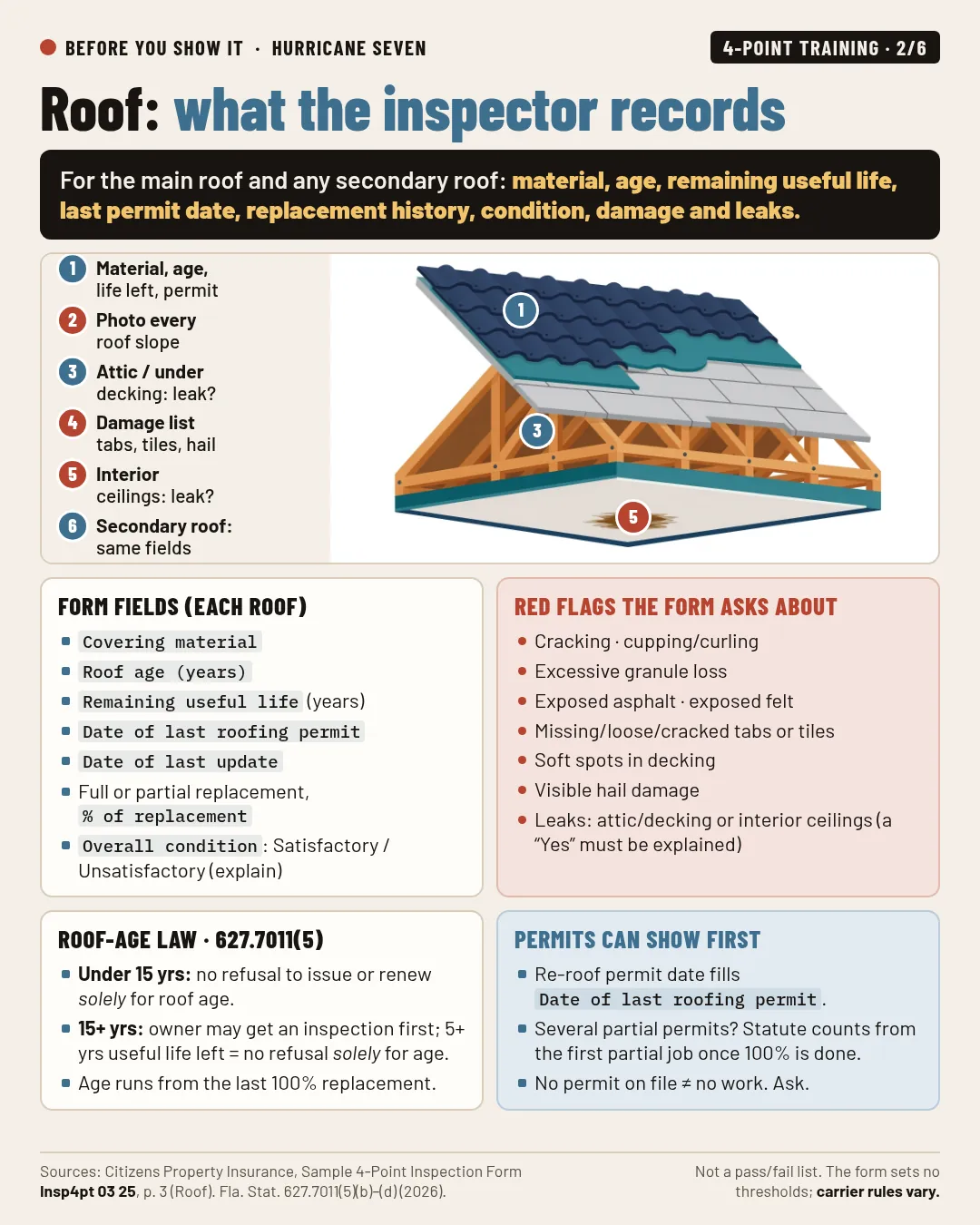
The inspector records, for the predominant roof and any secondary roof, the covering material, age, remaining useful life, last permit date, replacement history, overall condition, damage and leaks.
| Form field | What it records | Source |
|---|---|---|
| Covering material | What the roof is made of. The form gives a blank line, not a list of materials. | p. 3 |
| Roof age (years) | Age of the roof covering. | p. 3 |
| Remaining useful life (years) | Inspector's estimate of years left. | p. 3 |
| Date of last roofing permit | Date of the most recent roofing permit. | p. 3 |
| Date of last update | Date of the most recent roof work. | p. 3 |
| If updated: Full / Partial replacement; % of replacement | Whether the whole roof or part was replaced, and how much. | p. 3 |
| Overall condition | Satisfactory, or Unsatisfactory (explain below). | p. 3 |
| Visible signs of damage / deterioration | Checklist (see red flags). Check all that apply and explain. | p. 3 |
| Any visible signs of leaks? Attic/underside of decking; Interior ceilings | Yes/No for each. "Yes" must be explained. | p. 3; Citizens notice 3/20/25 |
Both columns repeat for a Secondary Roof. Photos of each slope are required. Citizens: "With photos of each roof slope, this section can take the place of the Roof Inspection Form" (p. 3).
Red flags the form asks about: cracking · cupping/curling · excessive granule loss · exposed asphalt · exposed felt · missing/loose/cracked tabs or tiles · soft spots in decking · visible hail damage · visible leaks in the attic/underside of decking or interior ceilings · overall condition Unsatisfactory.
System 2 · Electrical · Form p. 1
Electrical
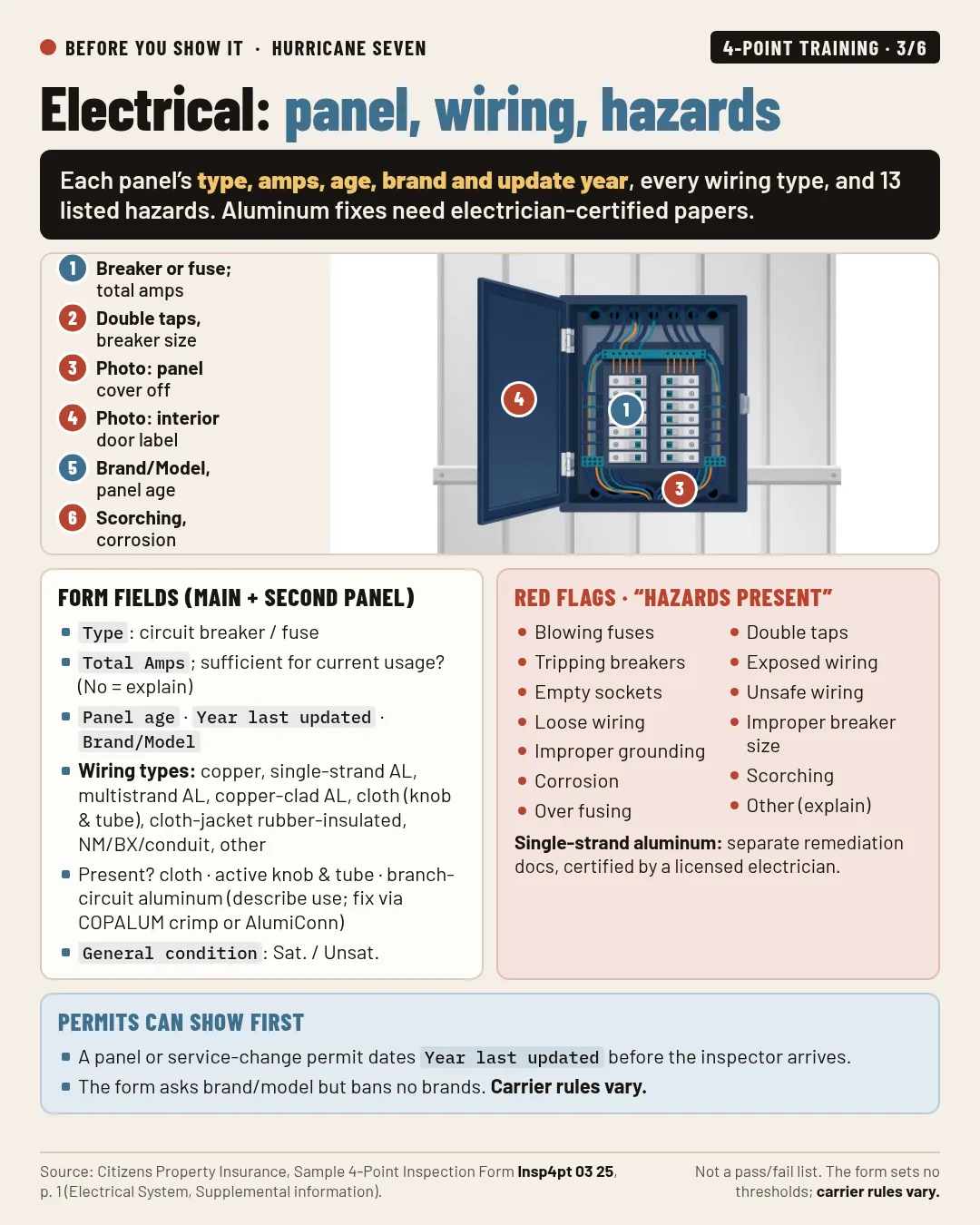
The inspector records each panel's type, amperage, age, brand/model and year last updated, every wiring type present, any of 13 listed hazards, and the system's general condition. Single-strand aluminum remediation needs separate documentation certified by a licensed electrician.
| Form field | What it records | Source |
|---|---|---|
| Main Panel / Second Panel: Type | Circuit breaker or fuse. | p. 1 |
| Total Amps | Rated amperage of the panel. | p. 1 |
| Is amperage sufficient for current usage? | Yes / No (explain). The form gives no minimum. | p. 1 |
| Indicate presence of | Cloth wiring; active knob and tube; branch circuit aluminum wiring (describe its usage). | p. 1 |
| Single strand (aluminum branch) remediation | Details of all remediation; connections repaired via COPALUM crimp or AlumiConn. Separate documentation of all work must be provided. | p. 1 |
| Hazards Present | 13 checkboxes (see red flags). | p. 1 |
| General condition of the electrical system | Satisfactory / Unsatisfactory (explain). | p. 1 |
| Supplemental: Panel age; Year last updated; Brand/Model | For main and second panel. | p. 1 |
| Wiring Type(s) | Copper; Single Strand AL; Multistrand AL; Copper Clad AL; Cloth (Knob & Tube); Cloth Jacket Rubber Insulated; NM, BX or Conduit; Other. | p. 1 |
Photos required: main electrical service panel with interior door label and electrical box with panel off (p. 1; p. 4 words it as "open main electrical panel and interior door"). A trade licensee such as an electrician may sign only the electrical section (p. 4).
Red flags the form asks about: blowing fuses · tripping breakers · empty sockets · loose wiring · improper grounding · corrosion · over fusing · double taps · exposed wiring · unsafe wiring · improper breaker size · scorching · other. Also: presence of cloth wiring, active knob and tube, or branch-circuit aluminum; amperage not sufficient; general condition Unsatisfactory.
The form header says: "Separate documentation of any single strand aluminum wiring remediation must be provided and certified by a licensed electrician" (p. 1). Citizens' 3/20/2025 notice says the 03 25 update clarified this requirement.
What county permits can show before the inspection: an electrical permit for a panel replacement or service change shows when it was done. That supports Year last updated and, for a new panel, Panel age. A permit is not the electrician's remediation certificate for aluminum wiring. The form asks for that as a separate document.
The form asks for Brand/Model but names no brands as unacceptable. Carrier rules vary on panel brands, fuses, minimum amperage and wiring types.
System 3 · Plumbing · Form p. 2
Plumbing
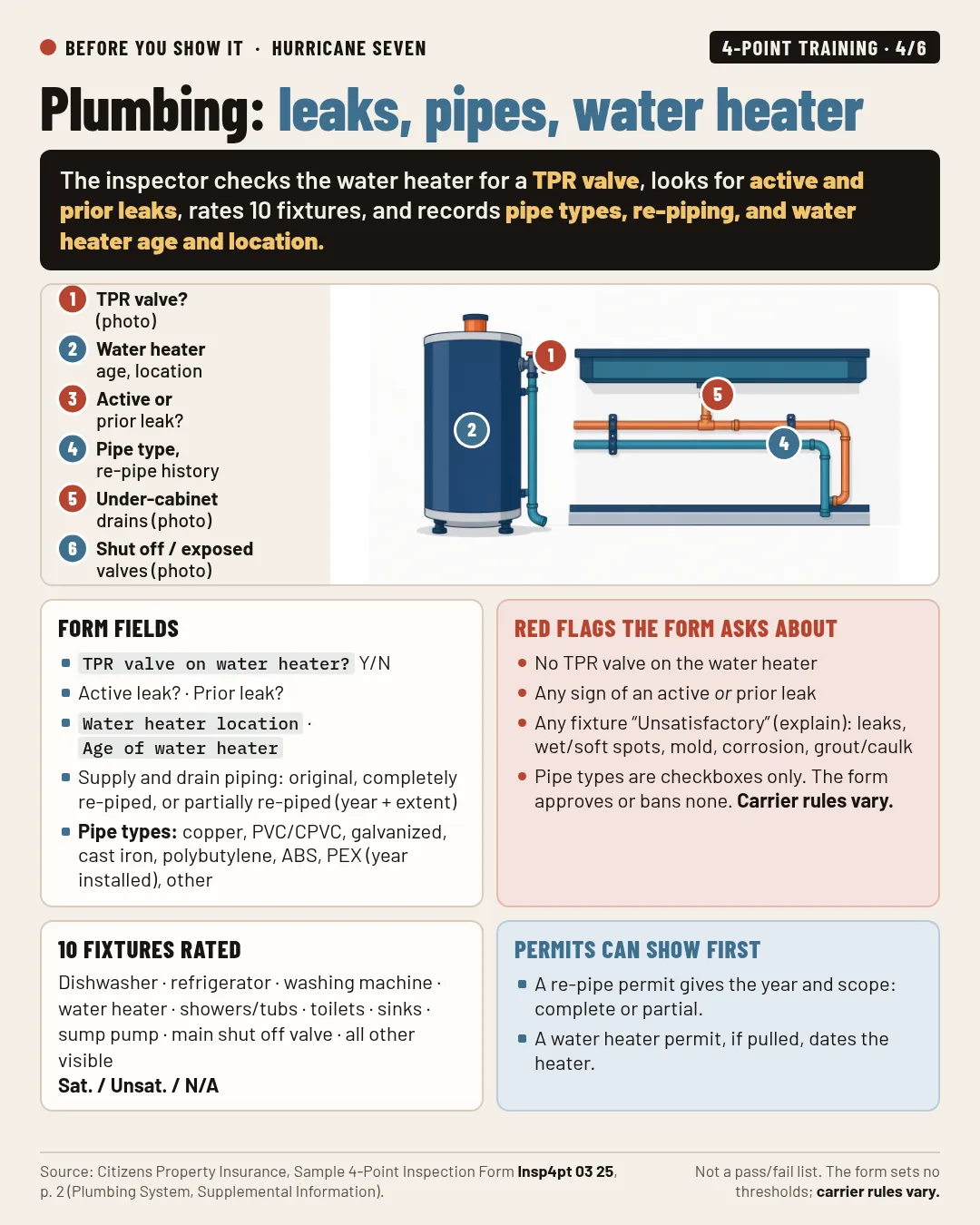
The inspector checks the water heater for a temperature pressure relief (TPR) valve, looks for active and prior leaks, rates 10 fixtures and connections, and records pipe materials, re-piping, and the water heater's age and location.
| Form field | What it records | Source |
|---|---|---|
| Is there a temperature pressure relief valve on the water heater? | Yes / No. | p. 2 |
| Is there any indication of an active leak? | Yes / No. | p. 2 |
| Is there any indication of a prior leak? | Yes / No. | p. 2 |
| Water heater location | Where it is (written in). | p. 2 |
| General condition of fixtures and connections to appliances | Satisfactory / Unsatisfactory / N/A for: dishwasher, refrigerator, washing machine, water heater, showers/tubs, toilets, sinks, sump pump, main shut off valve, all other visible. | p. 2 |
| If unsatisfactory, comments/details | Leaks, wet/soft spots, mold, corrosion, grout/caulk, etc. | p. 2 |
| Age of Piping Supply System / Drain System | Each: original to home; completely re-piped; partially re-piped. Give year and extent of renovation in comments. | p. 2 |
| Type of pipes (check all that apply) | Copper; PVC/CPVC; Galvanized; Cast Iron; Polybutylene; ABS; PEX (Year Installed); Other (specify). | p. 2 |
| Age of water heater | Written in. | p. 2 |
Photos required: water heater (including the TPR valve), under-cabinet plumbing/drains, exposed valves (p. 1). The TPR photo requirement was added in the 03 25 update.
Red flags the form asks about: no TPR valve on the water heater · any indication of an active leak · any indication of a prior leak · any fixture or connection rated Unsatisfactory (leaks, wet/soft spots, mold, corrosion, grout/caulk). The form lists polybutylene, galvanized and cast iron as checkboxes, like copper or PEX. It does not label any pipe type acceptable or unacceptable.
What county permits can show before the inspection: a re-pipe permit shows the year and may state whether the work was whole-house or partial. That is what the inspector writes under completely or partially re-piped, and it gives the PEX Year Installed if PEX was used. A water heater replacement permit, if one was pulled, dates the heater.
Carrier rules vary on pipe materials, water heater age and re-pipe requirements.
System 4 · HVAC · Form p. 2
HVAC
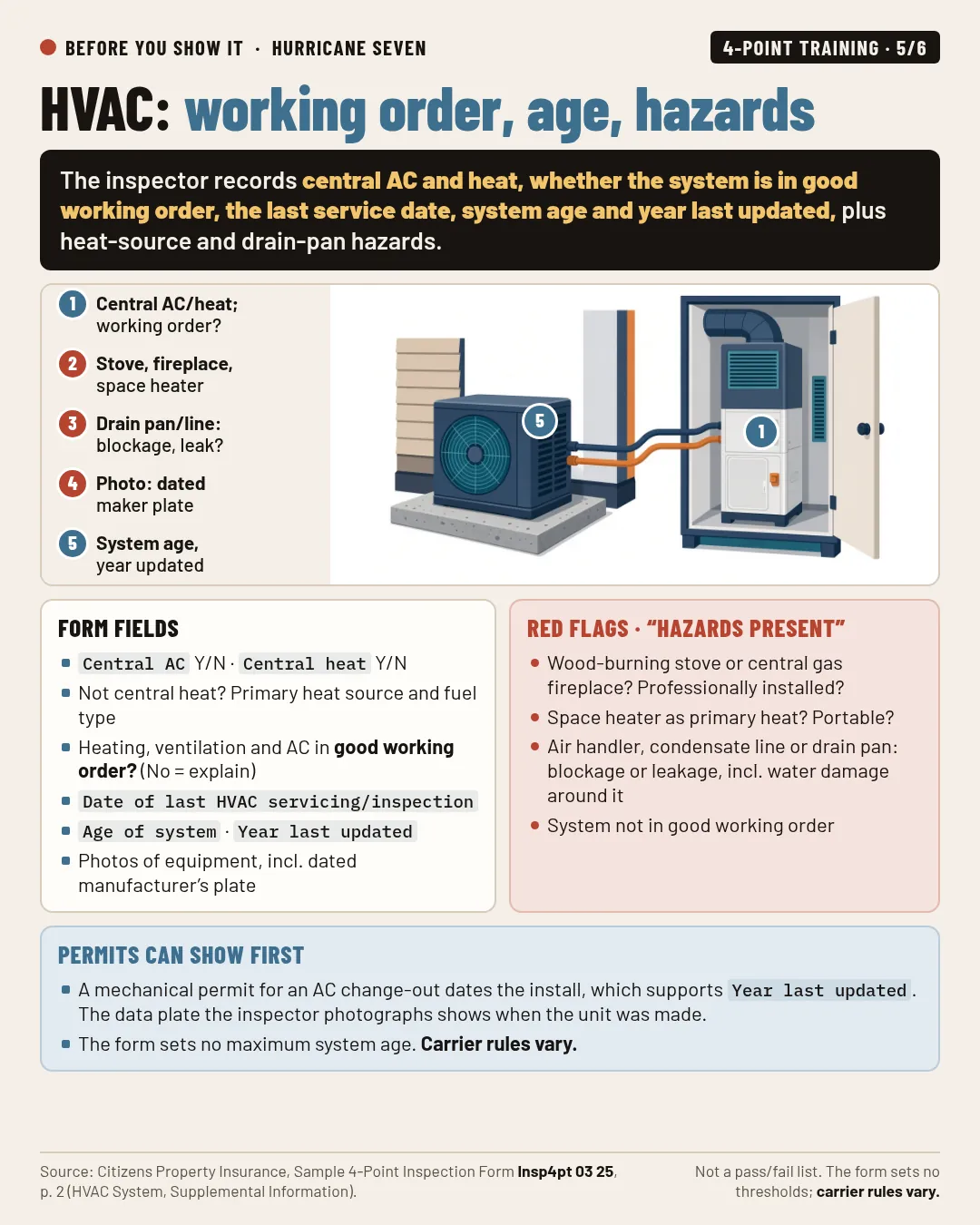
The inspector records whether the home has central AC and central heat, whether the heating, ventilation and air conditioning are in good working order, the date of last servicing, the system's age and year last updated, and four hazard questions.
| Form field | What it records | Source |
|---|---|---|
| Central AC | Yes / No. | p. 2 |
| Central heat | Yes / No. | p. 2 |
| If not central heat, primary heat source and fuel type | Written in. | p. 2 |
| Are the HVAC systems in good working order? | Yes / No (explain). | p. 2 |
| Date of last HVAC servicing/inspection | Written in. | p. 2 |
| Hazards: wood-burning stove or central gas fireplace present? Professionally installed? | Two-part yes/no (split into two parts in the 03 25 update). | p. 2; Citizens notice |
| Hazards: space heater used as primary heat source? Is the source portable? | Yes / No each. | p. 2 |
| Hazards: air handler/condensate line or drain pan blockage or leakage, incl. water damage to surrounding area? | Yes / No. | p. 2 |
| Supplemental: Age of system; Year last updated | Written in. | p. 2 |
| Photos | HVAC equipment, including the dated manufacturer's plate. | p. 2 |
Red flags the form asks about: HVAC not in good working order · wood-burning stove or central gas fireplace (and whether professionally installed) · space heater as primary heat (and whether portable) · signs of blockage or leakage at the air handler, condensate line or drain pan, including water damage around it.
What county permits can show before the inspection: a mechanical permit for an AC change-out shows when the new system went in, which supports Year last updated. The dated manufacturer's plate the inspector photographs is separate evidence of the unit's age. A service invoice gives the Date of last HVAC servicing/inspection. Permits don't show that.
The form sets no maximum system age. Carrier rules vary.
System 1 · Roof, continued
Roof age: the law and the permit
Florida law limits refusals based solely on roof age. Age counts from the last full replacement, or from the first partial replacement once later partials covered the whole roof. A dated permit can show that date before the inspection.
Roof age and the law · Fla. Stat. 627.7011(5) (2026)
- (b) An insurer may not refuse to issue or renew a homeowner's policy on a roof under 15 years old solely because of roof age.
- (c) Roof 15+ years old: the insurer must let the homeowner get a roof inspection by an authorized inspector, at the homeowner's expense, before requiring replacement. If it shows 5+ years of useful life left, the insurer may not refuse to issue or renew solely because of roof age.
- (d) Roof age runs from the last date 100% of the roof was built or replaced under the code then in effect, or from the first partial replacement when later partials brought it to 100%.
- (e) Applies to policies issued or renewed on or after July 1, 2022. (6) Does not apply to mobile home policies or non-homeowners policies, and does not stop an insurer from rejecting or nonrenewing for other lawful reasons or because the structure does not meet underwriting criteria for replacement cost or law and ordinance policies.
OIR's residential property forms checklist (May 2025) cites 627.7011(5)(b)&(c).
What county permits can show before the inspection: a re-roof permit shows a date and may show a scope. That date is what goes in Date of last roofing permit, and it is evidence for roof age under 627.7011(5)(d). Several partial-roof permits matter: the statute counts from the first partial once the roof reached 100%. No permit on file does not prove no work was done. Ask the seller.
Carrier rules vary on acceptable roof age by material and on what counts as "remaining useful life." The form sets neither.
Signing, photos, use · Form pp. 1, 3, 4
Who signs, photos, and how it's used
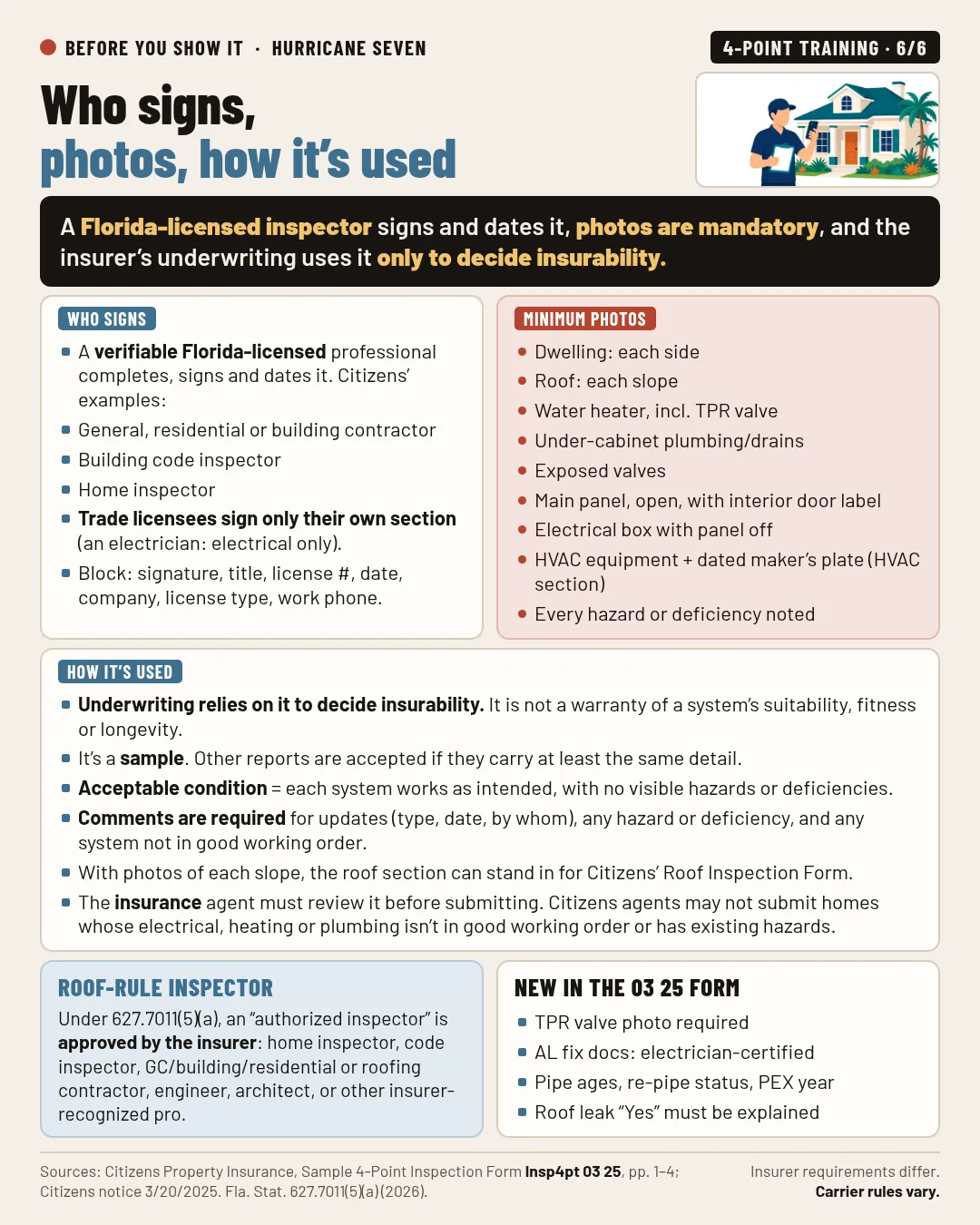
A verifiable Florida-licensed inspector completes, signs and dates the form. Minimum photos are mandatory. Underwriting relies on it only to decide insurability.
Who can sign
"To be accepted, all inspection forms must be completed, signed and dated by a verifiable Florida-licensed professional" (p. 4). Citizens' examples: a general, residential or building contractor; a building code inspector; a home inspector. "A trade-specific, licensed professional may sign off only on the inspection form section for their trade (e.g., an electrician may sign off only on the electrical section of the form)" (p. 4).
Signature block (p. 3): Inspector Signature, Title, License Number, Date, Company Name, License Type, Work Phone, with the line "I certify that the above statements are true and correct."
Different list for the roof-age statute. For a roof inspection under 627.7011(5), an "authorized inspector" must be approved by the insurer and be a licensed home inspector (s. 468.8314), a certified building code inspector (s. 468.607), a licensed general, building or residential contractor (s. 489.111) or a roofing contractor, a licensed professional engineer (s. 471.015), a licensed architect (s. 481.213), or another person or entity the insurer recognizes as qualified (627.7011(5)(a)).
Minimum photos
- Dwelling: each side · Roof: each slope
- Plumbing: water heater (including TPR valve), under-cabinet plumbing/drains, exposed valves
- Main electrical panel with interior door label (open) · electrical box with panel off
- All hazards or deficiencies noted · HVAC equipment including the dated manufacturer's plate (HVAC section)
How the form is used
- Underwriting relies on it, or a similar form from the licensed professional you choose, to determine insurability. It is not a warranty (p. 1).
- Any substitute report must include at least this level of detail (p. 4).
- The inspector certifies the condition of all four systems. Acceptable condition means working as intended with no visible hazards or deficiencies (p. 4).
- Additional Comments must give full details of updates (type, dates, by whom), any visible hazard or deficiency, and any system not in good working order (p. 4).
- The writing (insurance) agent must review the form before submitting it and make sure all rules are met before binding. Agents may not submit applications for homes with electrical, heating or plumbing not in good working order or with existing hazards or deficiencies (p. 4).
Carrier rules vary. These are Citizens' instructions. Other insurers may ask for different forms, photos or signers.
Depending on the findings, you may need to finish repairs before an insurer will issue a policy. (Florida CFO guide)
How long a 4-point is valid
Generally, the report must be dated within the 30 days before the insurance application is submitted. Each insurer sets the timeframe it accepts, so check with your insurer or insurance agent. (Florida CFO guide)
4-point vs. full home inspection
A full home inspection is not limited to these four systems. (CFO)
Check the inspector's license
The form must be completed, signed and dated by a verifiable Florida-licensed inspector, such as a home inspector or a general, residential or building contractor. (Citizens form, pp. 3–4; Florida CFO guide)
To verify a license, search the Florida DBPR license lookup. (Florida CFO guide)
Before the inspection
What to gather before the inspector arrives
Pull the permit history, then match each dated permit to the form field it answers.
| Form field | What it records | Source |
|---|---|---|
| Roof: Date of last roofing permit; Date of last update; Full/Partial; % | Re-roof permit date and scope. For several partial permits, all of them (627.7011(5)(d)). | Form p. 3; statute |
| Electrical: Year last updated; Panel age; Brand/Model | Panel or service-change permit date. Any aluminum-wiring remediation documents certified by a licensed electrician. | Form p. 1 |
| Plumbing: supply/drain original, completely or partially re-piped; PEX Year Installed; Age of water heater | Re-pipe permit date and scope; water heater permit, if pulled. | Form p. 2 |
| HVAC: Year last updated; Age of system; Date of last servicing | AC change-out permit date; most recent service invoice. | Form p. 2 |
| Header: Actual Year Built | Year built (property appraiser record). | Form p. 1 |
Where to look (local)
- Sarasota County (unincorporated): Permit Search, building.scgov.net
- City of Venice: eTRAKiT permit search, trakit.venicegov.com
- City of Sarasota: Permit Search, ftgportal.sarasotafl.gov (the city notes some residential permit data before 1997 may not be online)
How to find these: Florida building permit search and Sarasota County permit search.
Limits
- A permit shows that work was permitted and when. It does not show the system's condition today. The inspector still records condition.
- Unpermitted work won't appear. Older records may be missing online.
- Permit rules change. The Sarasota County and City of Venice building pages both post notices about Florida HB 803 residential permitting changes effective July 1, 2026. Check what applied when the work was done.
Hurricane Seven reads these dated permit lines (roof, AC, re-pipe, panel) for an address so buyers and agents see them before booking the 4-point. It does not replace the inspection or a licensed inspector's signature.
Example: a 1982 Venice house, field by field
49 Sandstone Cir, Venice FL 34293, Sarasota County. Built 1982, concrete tile roof. Source: county permit record via Hurricane Seven report.
- Roof (Good): permit
20 149648 00 BE, 8/24/2020, Closed, 35 SQ tile reroof. If that reroof covered the whole roof, the roof is about 6 years old, under 15, so under Fla. Stat. 627.7011(5)(b) an insurer may not refuse to issue or renew solely because of its age. - AC (Good):
22 179852 00 BE, 12/22/2022, replaced a 3-ton system. - Plumbing (Watch):
10 009948 00 BO, 3/22/2010, "REPIPE," scope not stated. Ask what was repiped. - Electrical (Good):
19 164821 00 BE, 11/13/2019, service change. - Windows (Problem): no window permit on record. Ask whether the openings are impact-rated. That's a wind mitigation question, not a 4-point one.
- Zones: Flood Zone AE, Evacuation Zone C.
FAQ
What fails a 4-point inspection in Florida?
There is no single statewide fail list; each insurer has its own criteria for the four systems, with slight variations between companies (CFO). On the Citizens form, acceptable condition means each system works as intended with no visible hazards or deficiencies, and Citizens agents may not submit applications for homes with electrical, heating or plumbing systems not in good working order or with existing hazards or deficiencies (Citizens form, p. 4).
Can you get insurance without a 4-point inspection?
It depends on the insurer: some require one to issue or renew a policy (CFO). Verify with your insurance company or agent.
How do you get a 4-point inspection?
Hire a Florida-licensed inspection professional, such as a home inspector or a general, residential or building contractor (CFO). They check the roof, electrical, plumbing and HVAC and give you a signed report with photos (Citizens form).
Do 4-point inspectors have to be licensed?
Yes. The form must be signed by a verifiable Florida-licensed inspector, and a trade-specific licensee may sign only their trade's section (Citizens form, pp. 3–4). Check a license at the DBPR license lookup.
How much does a 4-point inspection cost?
Prices vary by inspector and house; get quotes. (CFO)
How long is a 4-point inspection valid?
Generally, it must be dated within the 30 days before you apply, but each insurer sets its own window (CFO). Check with your insurer or agent.
Sources
Sources
All sources accessed October 10, 2026. Claim-by-claim citations are below.
| Source | URL |
|---|---|
| Citizens Property Insurance Corp., Sample 4-Point Inspection Form, Insp4pt 03 25 (PDF, 4 pp., created 3/19/2025) | citizensfla.com sample form |
| Citizens, "Roof and 4-Point Inspection Form Updates," 3/20/2025 | citizensfla.com form updates |
| Fla. Stat. 627.7011 (2026), Homeowners' policies; offer of replacement cost coverage and law and ordinance coverage. Subsections (5)(a)–(e), (6) | flsenate.gov 627.7011 |
| Florida Office of Insurance Regulation, Personal Lines Forms Checklist: Residential Property (May 2025), rows citing 627.7011(5)(b)&(c) | floir.gov residential property checklist |
| Sarasota County Permit Search; Building page (HB 803 notice) | building.scgov.net · Sarasota County building page |
| City of Venice eTRAKiT permit search; Building Department page (HB 803 notice) | trakit.venicegov.com · Venice building department |
| City of Sarasota Permit Search | ftgportal.sarasotafl.gov |
| Florida Department of Financial Services, Office of the Insurance Consumer Advocate (with InterNACHI), What to Expect: Four-Point Inspection (PDF) | |
| Florida DBPR, Licensing Portal: License Search | |
Not on the form, so not in this guide
- Maximum roof, panel, water heater or HVAC ages; minimum amperage; banned panel brands or pipe types. Carrier rules vary.
- Inspection prices.
- Wind mitigation inspections (a separate inspection and form).
General and header
| Claim | Citation |
|---|---|
| The form covers four systems: Electrical, HVAC, Plumbing, Roof | FORM pp. 1–3 section headers; p. 4 "Documenting the Condition of Each System" |
| Header fields: Insured/Applicant Name, Application/Policy #, Address Inspected, Actual Year Built, Date Inspected | FORM p. 1 header |
| Underwriting relies on it to determine insurability; not a warranty of suitability, fitness or longevity | FORM p. 1 boxed notice |
| The form is a sample. Not required, but any other report must include at least this level of detail | FORM p. 4 "Special Instructions" |
| Acceptable condition = each system working as intended, no visible hazards or deficiencies | FORM p. 4 "Documenting the Condition of Each System" |
| Additional Comments must detail updates (type, dates, by whom), visible hazards/deficiencies, any system not in good working order | FORM p. 4 "Additional Comments or Observations" |
| Writing agent must review the form before submitting; agents may not submit applications for homes with electrical, heating or plumbing not in good working order or with existing hazards/deficiencies | FORM p. 4 "Note to All Agents" |
| Form version 03 25 issued 3/20/2025; older versions not rejected, but underwriting may follow up | NOTICE |
| The form sets no pass/fail thresholds (no max ages, no minimum amps, no banned brands or pipe types) | FORM pp. 1–4 (absence: no such values appear anywhere on the form) |
Who signs
| Claim | Citation |
|---|---|
| A Florida-licensed inspector must complete, sign and date the form | FORM p. 1 ("A Florida-licensed inspector must complete, sign and date this form"); p. 3 ("verifiable Florida-licensed inspector") |
| Examples: general, residential or building contractor; building code inspector; home inspector | FORM p. 4 "Inspector Requirements" |
| A trade-specific licensee may sign only their trade's section (e.g., electrician: electrical only) | FORM p. 4 "Note" |
| Signature block: Inspector Signature, Title, License Number, Date, Company Name, License Type, Work Phone; "I certify that the above statements are true and correct" | FORM p. 3 |
| Roof-rule "authorized inspector": approved by the insurer; licensed home inspector (468.8314), certified building code inspector (468.607), general/building/residential contractor (489.111) or roofing contractor, PE (471.015), architect (481.213), or other insurer-recognized person/entity | STAT (5)(a)1–6 |
Photos
| Claim | Citation |
|---|---|
| Dwelling: each side; Roof: each slope | FORM p. 1 "Minimum Photo Requirements"; p. 4 "Photo Requirements" |
| Plumbing: water heater (incl. TPRV), under-cabinet plumbing/drains, exposed valves | FORM p. 1 (p. 4 omits "incl TPRV") |
| TPR valve photo newly required in 03 25 | NOTICE (Minimum Photo Requirements row) |
| Main electrical service panel with interior door label (p. 4: "Open main electrical panel and interior door") | FORM p. 1; p. 4 |
| Electrical box with panel off | FORM p. 1; p. 4 |
| All hazards or deficiencies noted | FORM p. 1; p. 4 |
| HVAC equipment photos incl. dated manufacturer's plate | FORM p. 2 HVAC Supplemental Information |
Roof claims
| Claim | Citation |
|---|---|
| Fields repeat for Predominant Roof and Secondary Roof | FORM p. 3 |
| Covering material (blank; no list of materials given) | FORM p. 3 |
| Roof age (years); Remaining useful life (years); Date of last roofing permit; Date of last update | FORM p. 3 |
| If updated: Full replacement / Partial replacement; % of replacement | FORM p. 3 |
| Overall condition: Satisfactory / Unsatisfactory (explain below) | FORM p. 3 |
| Damage/deterioration checklist: cracking; cupping/curling; excessive granule loss; exposed asphalt; exposed felt; missing/loose/cracked tabs or tiles; soft spots in decking; visible hail damage | FORM p. 3 |
| Visible signs of leaks (Yes/No, explain if yes): attic/underside of decking; interior ceilings | FORM p. 3 |
| A "Yes" on leaks must be expanded | NOTICE (Roof row); FORM p. 3 |
| With photos of each slope, roof section can take the place of the Roof Inspection Form | FORM p. 3 section header |
| Under 15 yrs: insurer may not refuse to issue or renew solely because of roof age | STAT (5)(b); OIR checklist rows citing 627.7011(5)(b)&(c) |
| 15+ yrs: insurer must allow inspection by an authorized inspector at the homeowner's expense before requiring replacement; 5+ yrs useful life remaining = no refusal solely for roof age | STAT (5)(c); OIR |
| Roof age = last date 100% was built/replaced under the code then in effect, or initial date of partial replacement when later partials reached 100% | STAT (5)(d) |
| Applies to policies issued or renewed on or after July 1, 2022 | STAT (5)(e) |
| Does not apply to non-homeowners policies or mobile home policies; does not limit rejection for underwriting criteria or other lawful reasons | STAT (6)(a)–(c) |
Electrical claims
| Claim | Citation |
|---|---|
| Separate documentation of single-strand aluminum remediation must be provided and certified by a licensed electrician | FORM p. 1 section header; NOTICE (Electrical row, "clarified") |
| Main and Second Panel: Type (circuit breaker / fuse); Total Amps; Is amperage sufficient for current usage? Yes / No (explain) | FORM p. 1 |
| Indicate presence of: cloth wiring; active knob and tube; branch circuit aluminum wiring (describe usage) | FORM p. 1 |
| Single-strand remediation details; connections repaired via COPALUM crimp or AlumiConn; separate documentation | FORM p. 1 |
| Hazards Present (13): blowing fuses, tripping breakers, empty sockets, loose wiring, improper grounding, corrosion, over fusing, double taps, exposed wiring, unsafe wiring, improper breaker size, scorching, other (explain) | FORM p. 1 |
| General condition: Satisfactory / Unsatisfactory (explain) | FORM p. 1 |
| Supplemental: Panel age; Year last updated; Brand/Model (main and second panel) | FORM p. 1 |
| Wiring types: Copper; Single Strand AL; Multistrand AL; Copper Clad AL; Cloth (Knob & Tube); Cloth Jacket Rubber Insulated; NM, BX or Conduit; Other | FORM p. 1; NOTICE (wiring types added) |
| Form names no unacceptable panel brands | FORM p. 1 (absence) |
Plumbing claims
| Claim | Citation |
|---|---|
| TPR valve on the water heater? Yes/No | FORM p. 2 |
| Indication of an active leak? Of a prior leak? Yes/No | FORM p. 2 |
| Water heater location | FORM p. 2 |
| Fixtures (Satisfactory/Unsatisfactory/N/A): dishwasher, refrigerator, washing machine, water heater, showers/tubs, toilets, sinks, sump pump, main shut off valve, all other visible | FORM p. 2 |
| If unsatisfactory: leaks, wet/soft spots, mold, corrosion, grout/caulk, etc. | FORM p. 2 |
| Age of piping supply and drain systems: original to home / completely re-piped / partially re-piped; year and extent in comments | FORM p. 2; NOTICE (Plumbing row) |
| Pipe types: copper, PVC/CPVC, galvanized, cast iron, polybutylene, ABS, PEX (year installed), other | FORM p. 2; NOTICE |
| Age of water heater | FORM p. 2; NOTICE |
| Form labels no pipe type acceptable or unacceptable | FORM p. 2 (absence) |
HVAC claims
| Claim | Citation |
|---|---|
| Central AC Y/N; Central heat Y/N; if not central heat, primary heat source and fuel type | FORM p. 2 |
| HVAC in good working order? Yes / No (explain) | FORM p. 2 |
| Date of last HVAC servicing/inspection | FORM p. 2 |
| Hazards: wood-burning stove or central gas fireplace present? Professionally installed? | FORM p. 2; NOTICE (split into two parts) |
| Hazards: space heater as primary heat source? Portable? | FORM p. 2 |
| Hazards: air handler/condensate line or drain pan blockage or leakage, incl. water damage to surrounding area | FORM p. 2 |
| Supplemental: Age of system; Year last updated; photos incl. dated manufacturer's plate | FORM p. 2 |
Permits
| Claim | Citation |
|---|---|
| The roof section asks for "Date of last roofing permit" | FORM p. 3 |
| Panel "Year last updated," HVAC "Year last updated," re-pipe status and PEX "Year Installed" are form fields a dated permit can inform | FORM pp. 1–2 (field names). The link from permit to field is our interpretation, not a statement in the form. |
| Sarasota County has an online permit search by property, permit type and date range | SCC |
| City of Venice eTRAKiT searches permits by number, parcel, address, type | VEN |
| City of Sarasota: some residential permit data before 1997 may not be online | SRQ |
| Sarasota County and Venice building pages post notices on Florida HB 803 residential permitting changes effective July 1, 2026 | SCC Building page; VEN Building page (notice titles only; HB 803 content not reviewed) |
| "No permit on file does not prove no work"; "a permit doesn't show current condition" | General caution, not from a source. Labeled as such in the guide. |
Training material, not legal or insurance advice. Confirm current requirements with the insurer.
See the permit dates before the inspector does
Hurricane Seven reads the county permit file for a Sarasota County address. You get a plain verdict box with check and warning lines, the 7 grades, and every county permit as a dated line with the original county wording one tap away, on a permanent snapshot link. It shows what the record says; it is not an inspection. Hurricane Seven does not cover Longboat Key.